“Life is a bucket of shit with a barbed wire handle.”
– Jim Thompson, Texas By The Tail
“Life is a bucket of shit with a barbed wire handle.”
– Jim Thompson, Texas By The Tail
 |
| Todd's customization job. |
 |
| Mel, Laura, me, & Todd: Ready to set off to Alaska. |
 |
| Carpet. |
 |
| The "Green Egg Van" in Seward, AK. |
 |
| Two Gills in two Econoliners. |
 |
| Let the Sun Shine: Donald & the blue Econoliner. |
 |
| The blue Econoliner from my apartment window, Anchorage, 1997. |
 |
| Tire stud informational display. |
People sometimes use chains in the continental states, but the studs are better for long-term daily use (winters are a lot longer up there).
They're an extra expense, the unused set of tires (studded in summer, regular in winter) requires storage space, and changing them is another annoying task on the To-Do list every 6 months or so.
In Anchorage, modern apartment complexes had electrical outlets available on posts located in the parking lot, one for each parking space.
In Dillingham, we would run an industrial extension cord from the house to the van.
Here is a photo of me changing a tire on the ice, using a lever made from firewood to assist my piece-of-crap jack:
 |
| Changing a tire in a frozen driveway. |
Dillingham, Alaska, when my brother Todd and I were there (1995–1997), was a very secluded part of the world—it still is, I guess, but internet availability probably changes a lot. When I was there, we had no internet, though we did have cable TV, so we weren’t entirely disconnected in terms of information, even back then. It was certainly physically disconnected, though. There were no roads to or from Dillingham; it was more of a hub town for a handful of scattered Yu'pik villages and a boat harbor with access to Bristol Bay. No fast food, though there were a couple of restaurants, bars, and grocery stores.
One year, our supervisor directed us to participate in the local parade. We drove the company van through the streets of Dillingham. While we didn’t have it together enough to create a proper float, we felt we should haul something, so we put an old Nordic Track exercise machine on the flatbed trailer and hauled that behind us. Our supervisor created a wooden figure which we all referred to as the “Walk Dude.” We added a few balloons and some signage to identify ourselves, and we were good to go.
 |
| The company van. |
 |
| The "Walk Dude." |
 |
| Signage, balloons, and brother Todd. |
 |
| Driving into town. |


Probably our most outrageous source of entertainment in Dillingham was the potato launcher.
Our boss built it from PVC pipe—just the right diameter to snugly fit a potato down the barrel. At the base, he attached a wider plastic chamber with a screw-off cap, where we’d spray in the “fuel”: Aqua Net hairspray. (It worked great until they changed the formula; after that, we had to switch brands. The key was finding something flammable.)
He rigged it with an old electric grill starter and a bolt inside the chamber, so all it took was pressing a red button to send a spark across the chamber and ignite the hairspray. We kept a broomstick handy to use as a ramrod whenever a potato didn’t quite fit.
When you hit the button, it let off a loud bang that echoed through the trees, and the potato launched with surprising velocity. My supervisor once speculated that a direct hit could break a man’s ribs.
 |
| Potato Launcher. |
 |
| Taking aim. |
 |
| Todd prepares to launch a potato. |
We used to set up targets in the backyard and fire the potato gun at them—usually an old trash can lid propped up with rocks.
That was one of the perks of living in the middle of nowhere. There’s no way we could’ve gotten away with that in a suburban neighborhood without drawing the attention of the neighbors—and probably law enforcement.
 |
| Our crew, most days. |
 |
| Skif Pilot Jonnie. |
 |
| The old barge. |
 |
| Todd welcoming us aboard. |
 |
| Glen tying anchoring our skif to the barge. |
 |
| Fishing off the barge. |
 |
| Remains of a WWII era bathroom. |
Canned meat has been a part of my life, and I’m happy to share this memory:
Chicken of the Sea – Back when I was living in the Alaskan Bush (pre-internet), entertainment was scarce. To pass the time, I started writing to companies in hopes of getting free coupons. One day, I wrote a letter to Chicken of the Sea, claiming that I had found a chicken feather in my can of tuna. I told them it was probably the result of a worker on the production line who thought it would be funny play on the product name.
Chicken of the Sea replied, saying that it was very unlikely for a worker to have done that, due to their stringent quality control processes. However, they did send me two coupons for free cans of tuna.
 |
| Seward Boat Harbor. |
 |
| Me with a salmon I caught. |
 |
| Either Snake Lake, or Lake Aleknagik. |
 |
| Baby Bear on the shore of Lake Aleknagik. |
 |
| Brother Todd eating a caribou rib. |
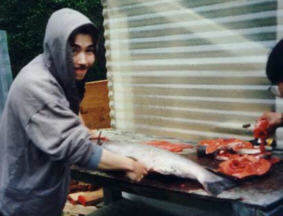
You could catch a lot just by fishing for them normally, but members of the native population were able to apply for set net permits, which would really bring in a bounty. Set netting involves anchoring and setting out a net on the beach at low tide. The net fills with fish at high tide, then you return again at the next low tide to gather your catch.
This method made for an abundant catch, but it also involved a lot of work cleaning all the fish before they went bad. It also required a lot of freezer space, but it only took setting the net two or three times to be supplied with salmon for the rest of the year.
 |
| After a day of fishing. |
 |
| Checking the set net at low tide. |
 |
| Fillet-master Mike. |
 |
| Look at those fillets. |
 |
| DP & me. |
 |
| Gill Bros. checking the smoker. |
 |
| Smoked deliciousness. |
 |
| At the Gaslight w/ Dale. |
I don't spend much (actually, any) time in bars these days, but I used to when I lived in Anchorage. I wish I had half the money I've pissed away in Anchorage bars.
My favorite spot was the downtown 4th Avenue district; they had a great selection of working-class dive bars there, never mind the occasional shooting. If you got kicked out of one, or if you were just bored, you could walk down the street and hang out at a different one.
In my mind at the time, 4th Avenue was a magical place where anything could happen. I used to have a ton of 4th Avenue bar stories, but I've forgotten most of them. They were never all that great anyway, once sobriety set in.
When there was music at all, it wasn't too loud, so you could better eavesdrop on people talking shit to each other, which I appreciated.
I'd always tell people how great the 4th Avenue bars were, then they'd join me and nothing interesting would happen. That's about when I realized my ton of 4th Avenue bar stories was more the result of my hanging out there constantly, rather than anything to do with the character of the bars themselves. If you hang out anywhere day and night, you're bound to witness a few interesting occurrences.
Anyway, the 4th Avenue dive bars were a lot of fun at one time, and they gave me something to do in Anchorage, but I probably did persist with it past its prime. Oh well.


